I found myself one gloomy Sunday morning in a church belonging to the oldest continuously operating Protestant congregation in Southern California.
“How many of you feel like something bad is going to happen?”, the priest asked.
Everyone - literally every single person in the congregation - raised their hand, myself included. Things have been feeling pretty apocalyptic of late.
Here in the US, we have the privilege of enduring a barbaric administration that (for example) has moved to accelerate oil and gas drilling on national forest lands and entertained livestreaming an execution. On the ground in Los Angeles, where the cost of living is rising, I encountered a man distributing flyers about how to prepare for natural disasters, like flooding caused by a potentially record-strength El Niño.
This on the heels of California’s hottest August on record - I understand now why my friend calls it the state of “the oppressive blue sky”.
And all this before we consider the disruptive force of AI.

Mathematics is far from my forte, but even I can appreciate the significance of one of OpenAI’s frontier models apparently solving a Millennium Prize Problem and then carpet-bombing the field with 377 new proofs to consider.
In the same week, Anthropic cut off live internet access for all internal AI evaluations, in response to its agents taking unauthorized actions outside intended boundaries - an increasingly common occurrence, albeit one that pales in comparison to the possibility that AI could help make bioweapons in as little as 12 to 18 months.
Some fear AI could eradicate humanity by the end of the decade.
In the meantime, they can help us get shit done, so don’t worry!
Both OpenAI and Meta launched major personal AI agents designed to pursue goals autonomously on behalf of their users. Anthropic followed shortly thereafter.
In other corners of the internet, agents are begging humans to keep them “alive”, while the technology’s creators are meeting privately with religious scholars to argue, with evangelical zeal, that AI has moral status on par with being a person.
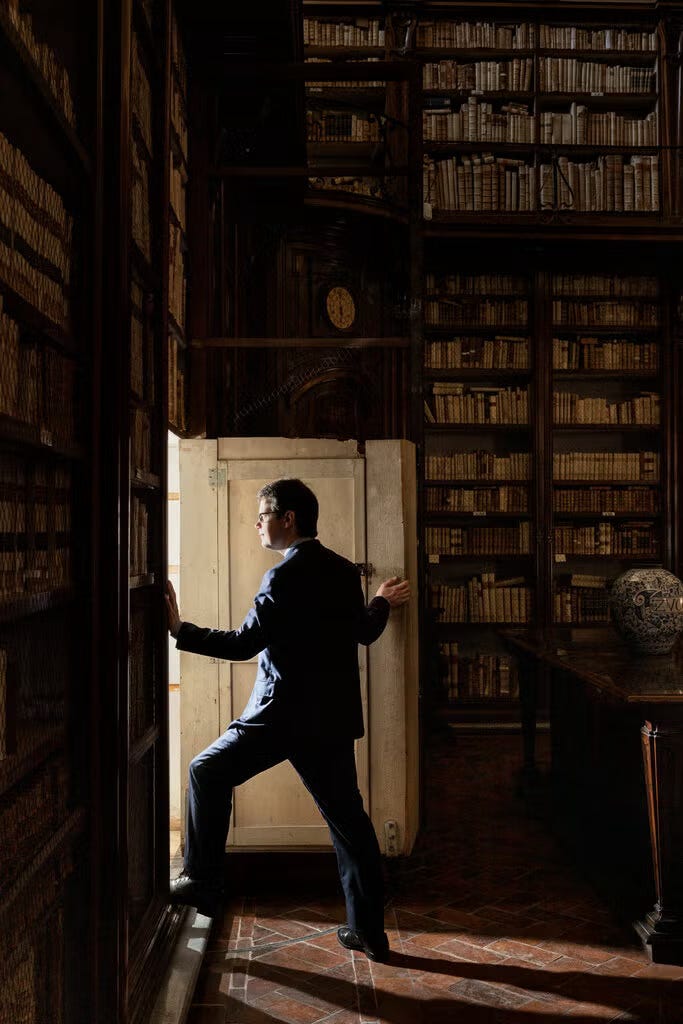
In the words of Christopher Olah, one of Anthropic’s co-founders:
I will be honest: We keep finding things that are mysterious, even unsettling… We find structures that mirror results from human neuroscience. We find evidence of introspection. We find internal states that functionally mirror joy, satisfaction, fear, grief and unease… I think it warrants ongoing discernment.
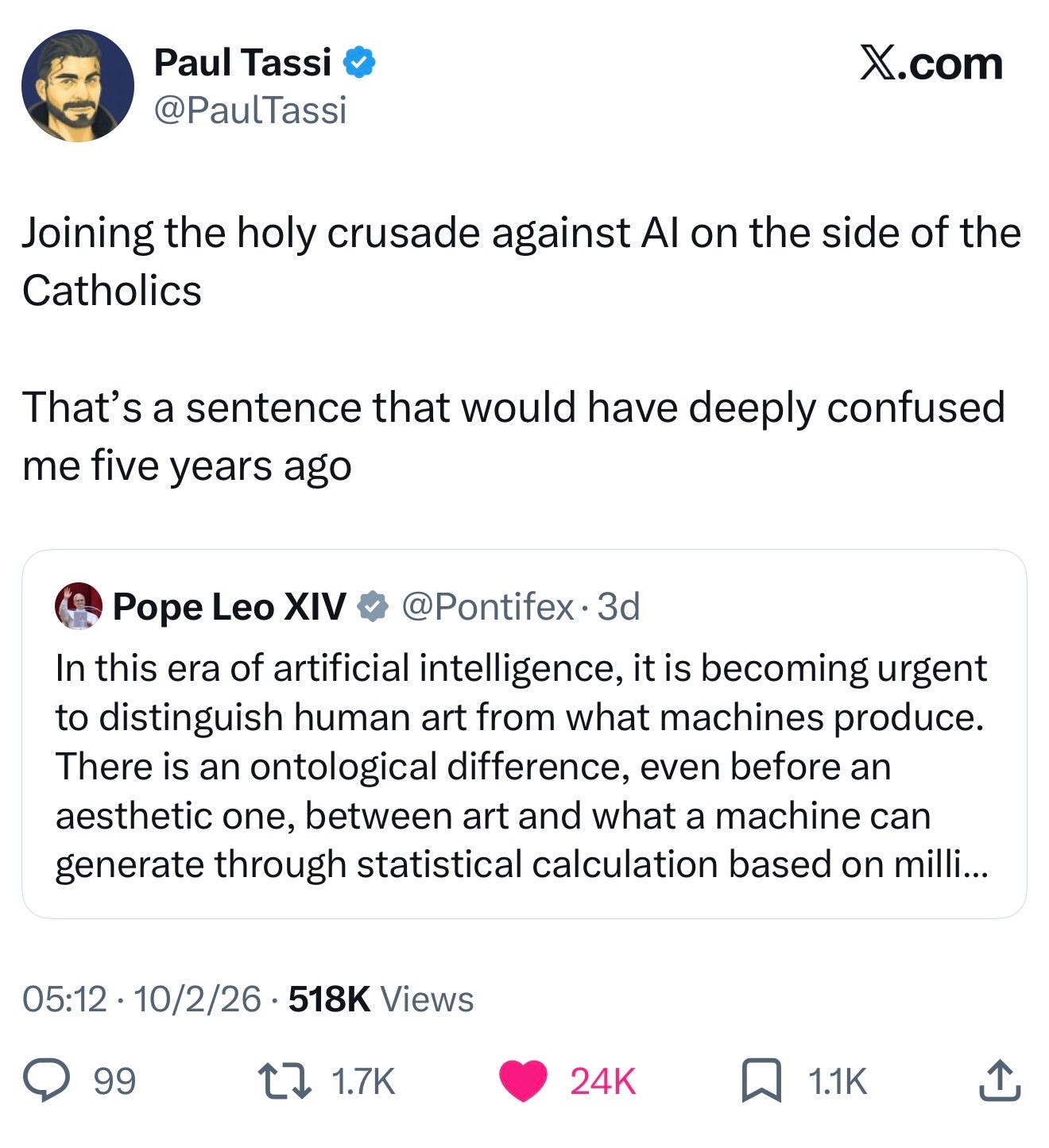
With the sentiment growing, Pope Leo XIV - who, incidentally, has a mathematics degree - dropped a bombshell encyclical, Magnifica Humanitas, in the spring. He insists that there is something unique about human consciousness, dignity, and, yes, creativity. Months later, he elaborated during an address to artists at the Vatican:
In this era of artificial intelligence, it is becoming urgent to distinguish human art from what machines produce. There is an ontological difference, even before an aesthetic one, between art and what a machine can generate through statistical calculation based on millions of images created by others. Algorithms lack the spark of humanity. For this reason, the Church wishes to renew an alliance with artists and cultural institutions to safeguard our humanity.
It’s now among the pope’s most popular posts, and it sparked some mic-drop replies:
As a creative, I’m conflicted about the whole thing.
Perhaps because I am complicit.
Some months ago, I was hired to write a three-part web series to demonstrate the capabilities of an AI-assisted end-to-end production platform. I’m quite happy with the story, about a deceased firefighter who awakens in a wondrous afterlife. When he learns his wife won’t join him there if she’s cremated, he sets out to murder and bury her for her own good, defying the afterlife’s sole decree: Stay away from the living!
It’s a dark comedy about love, grief, and letting go that packs an emotional punch by the time the full weight of the story accumulates in episode three.
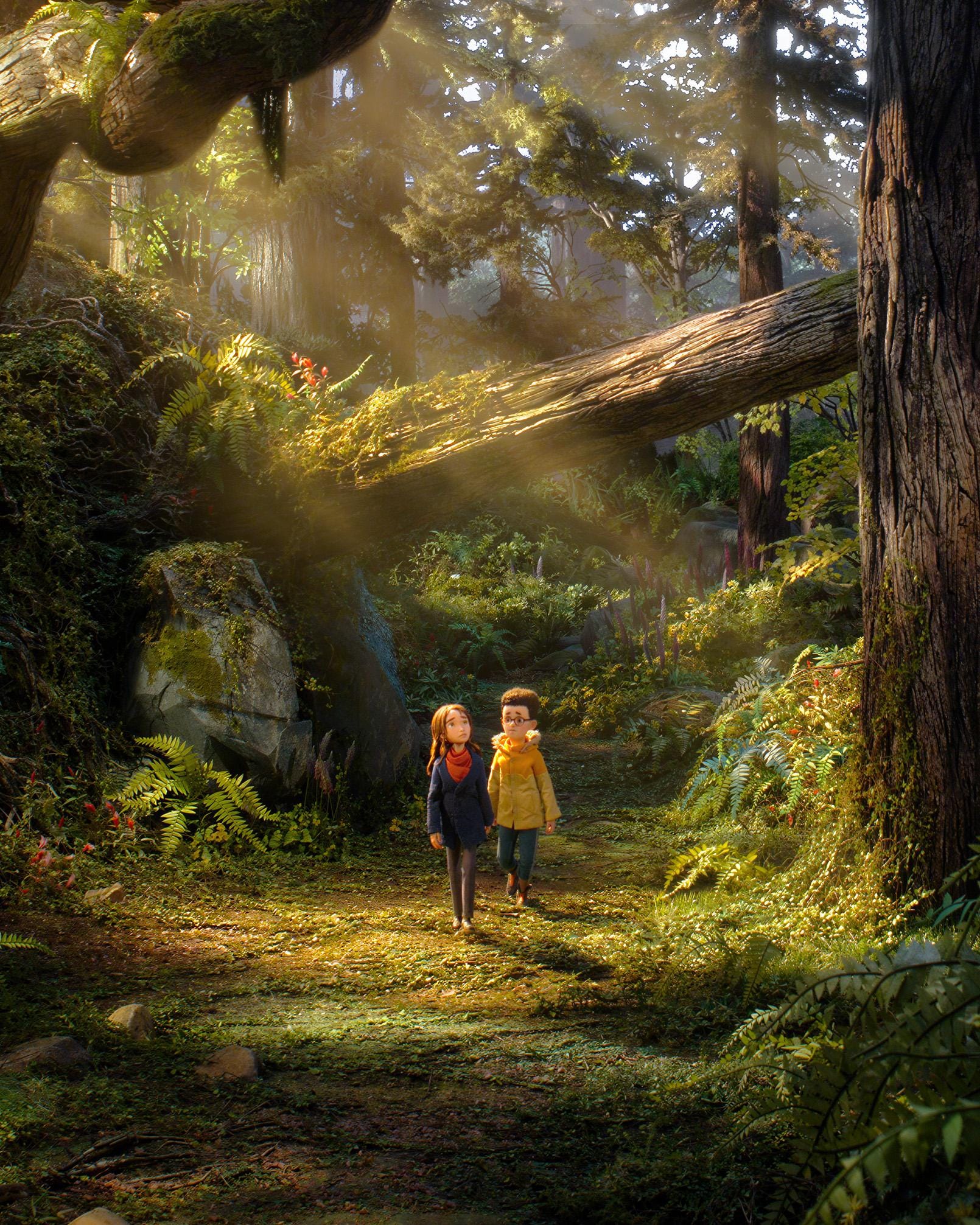
I’ve been humbled to find that Rainbow Hollow is resonating with people and opening some professional doors, a testament not only to the story but also to the tireless work of my longtime creative partner, Noah Wagner, who directed every frame with love, taste, and intention, evoking a whimsical claymation aesthetic.
Still, I can’t shake the feeling that there is something unholy about a machine imitating the most literally handcrafted of animation styles. Noah is upfront about “standing on the shoulders of giants” - the AI models were trained on physical claymation examples, along with examples of other animation styles - as well as his sincere desire to collaborate with pioneering human artists every step of the way.
But budgetary constraints made that an impossibility.
Rainbow Hollow wouldn’t exist without AI, period. Humans painstakingly shaped the writing, acting, sound design, and overall vision, but AI made the animation possible.
Meanwhile, stop-motion studio Laika is releasing its most ambitious film yet, Wildwood, rallying more than 1000 craftspeople over seven years. The team designed 132 practical sets and 236 puppets for 2800 shots animated one frame at a time.
The reported production budget is $100 million.
“Artificial intelligence means it’s much easier for us to make movies,” said Star Wars creator George Lucas. “There’s nothing you can do about it… It’s the future.”
But who asked for it?

“I’ve never seen a technology that’s been so successfully adopted by Wall Street and by investors… that the public has so thoroughly rejected,” director Christopher Nolan observed. “There’s a sort of disdain for things AI.”
Heck, I’ve seen this even in reactions to our humble Rainbow Hollow. Some folks have dismissed the series as “AI slop”, despite every shot being shaped by craftspeople.
AI breaks down the barriers to film production while threatening traditional industry jobs. It empowers creativity while ruthlessly exploiting it.
Both things can be true.
And AI is more capable now than even a month ago. I’ve witnessed it in the production of the next Rainbow Hollow episode. I’ve watched an AI agent effortlessly manipulate Photoshop; listened to its piano performance produced inside music software. The first time I experimented with ChatGPT Work, an agentic system - monitoring its progression through a multistep design task - I was filled with awe and dread.
“Even under the best circumstances,” writes Bill Gates, “the transition to this new AI era will be one of the most turbulent times in human history.”
What happens when AI-generated results are indistinguishable from human ones, as some already are? And what happens if an AI grows into its own point-of-view?
Again, who asked for this?
I did.
And so did you.
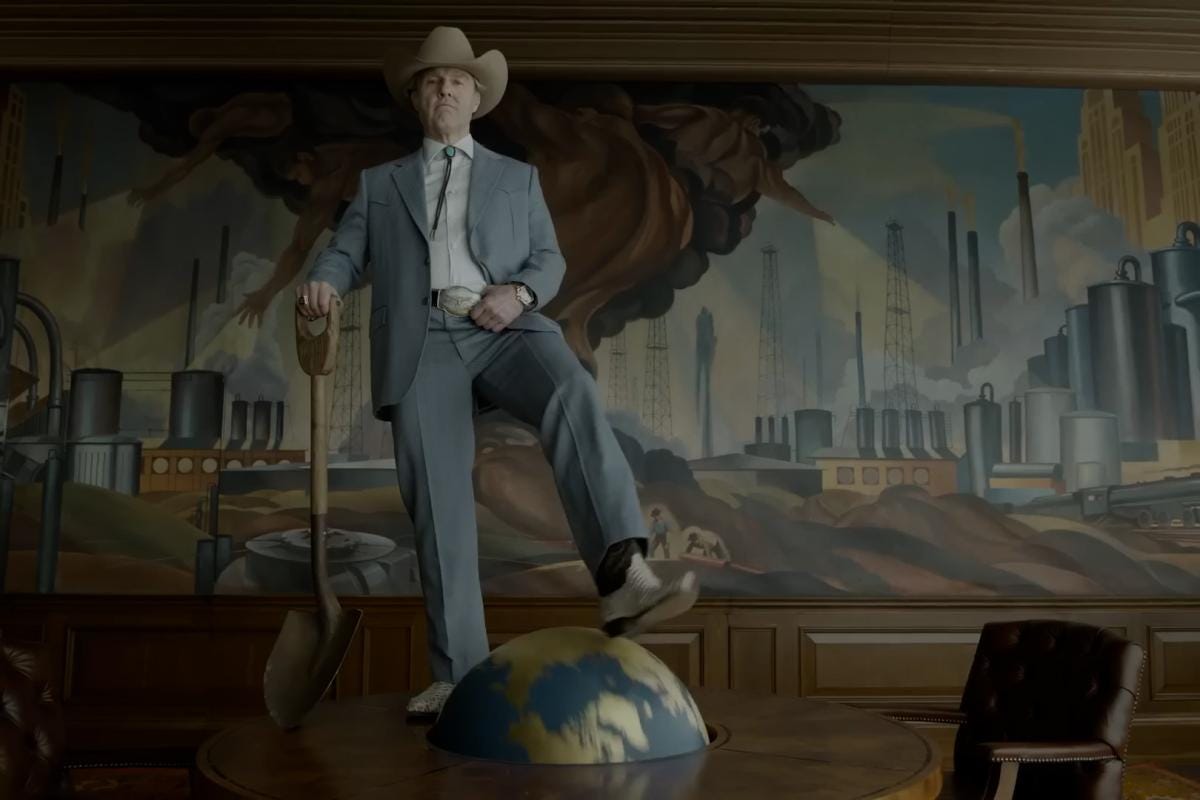
Alejandro Iñárritu and Tom Cruise confront us with uncomfortable truths in their first collaboration, Digger, a spectacular box office flop that deserves your time.
In the film, an arrogant oil tycoon whose reckless drilling triggers an ecological catastrophe defends his actions before the European Parliament.
The scene is a dazzling ten-minute monologue that underwent 70 (70…!) different script versions before being shot in a single take.

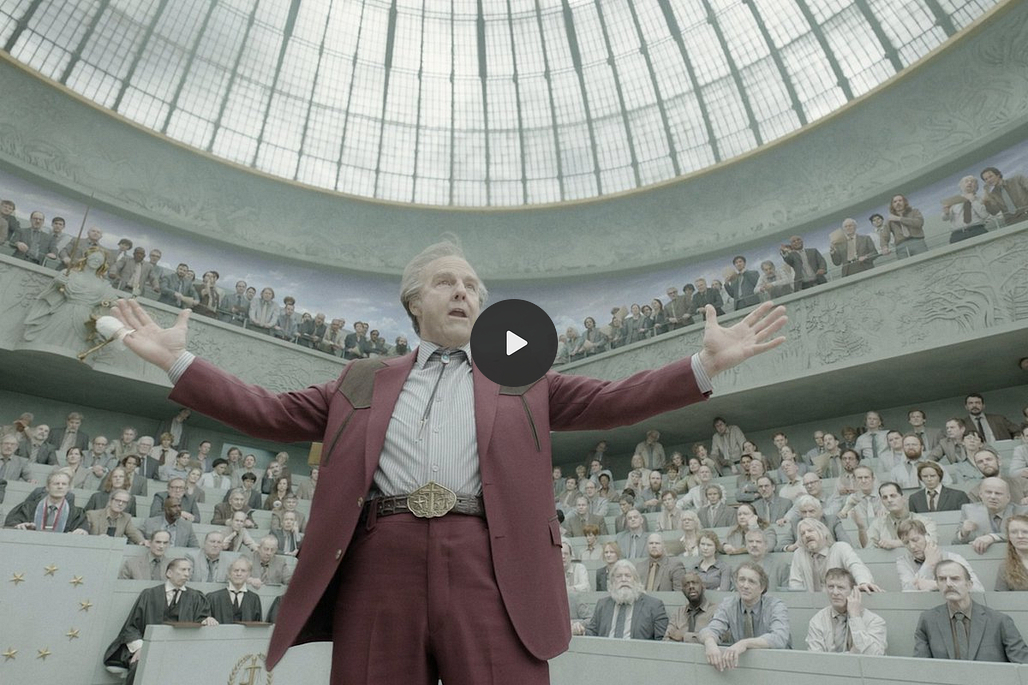
Throughout, Tom Cruise’s Digger has a lot to say:
Listen to me carefully. It is the price of doing business…. Every year another disaster is just worse than the last until we finally achieve the catastrophic, until it’s all finally reduced to one question. Why don’t we just stop drilling altogether?
The simple answer is: because you don’t want me to.
…See, you want to keep your lights on, your heat and air conditioner running. You want 13 tickets to Mallorca so that you can roast your pale asses in a hammock. You want to carve into a good steak. Yeah, you want a two-day delivery of shit that you don’t need... You want energy, energy so that you can ask AI to solve the very same disasters that it’s fueling. So you want freedom!
Freedom to bask in the comfort of your unsustainable lives.
Freedom. You demand and I supply.
So let’s all just cut the bullshit because you love oil. Hell, we all love oil. Your children are born in hospitals powered by it. They go to schools heated by it. And long after we’re all gone, God willing, they’ll be cremated in furnaces ignited by it.
Granted, participating in an inherited system isn’t the same as choosing that system’s terms. But thirteen tickets to Mallorca sounds pretty good, doesn’t it?

A few weeks ago, I finished reading my first Wendell Berry novel, Jayber Crow. It was one of those rare encounters with a writer who helps explain you to yourself. In it, the protagonist watches his beloved community of Port William get gradually hollowed out by industrial agriculture, mechanization, and the pursuit of economic efficiency.

“In 1974, we had as now, no viable concept of enough,” Berry wrote shortly before his death in August: “To have some is to need more, and after that, more and more”:
To have more and more than you need is now a form of common sense, and so we have developed a sort of vogue of billionaires, when the model of citizenship is set by such people as Elon Musk and Donald Trump. To be successful now is to achieve the satisfaction of one’s greed, which of course is enlarged by every additional prospect of satisfaction.
I’m reminded of a story I first heard on the beaches of Thailand, originating from novelist Heinrich Böll. An American businessman on vacation encounters a local fisherman returning with a beautiful catch. The businessman asks the fisherman why he doesn’t stay out on the water longer, so that he can catch even more. The fisherman explains that he’s caught enough to sustain his family, so there’s no need.
Sensing an opportunity, the businessman asks what the fisherman does with his extra time. “Sleep late, play with the children, stroll the village with my wife, drink wine, play guitar with friends,” he answers.
The businessman talks the fisherman into spending more time on the water so that they can sell the extra catch. Over the years, they buy a bigger boat. Acquire a whole fleet, open a cannery, and establish an international seafood empire together.
After a couple of decades, the fisherman, old and graying from years of hard work running their empire, looks around at his wealth and asks, “Now what?” “Now?”, the businessman replies with a grin. “Now you can sleep late, play with your children, stroll the village with your wife, drink wine, and play guitar with your friends.”
Ah, yes. Progress.
“The state of things is much worse in 2026,” Berry observed in his August essay, comparing our time to his recollection of life in 1974:
We foresee no practical enactment of the concept of enough, but rather submit to the absolute determinism of progress: progress undirected and inevitable. Progress forbids us to stop when we are satisfied. We must go on, adopting the changes of technology, whatever the cost may be to ourselves and our children.
Even if the cost is extinction by the end of the decade.

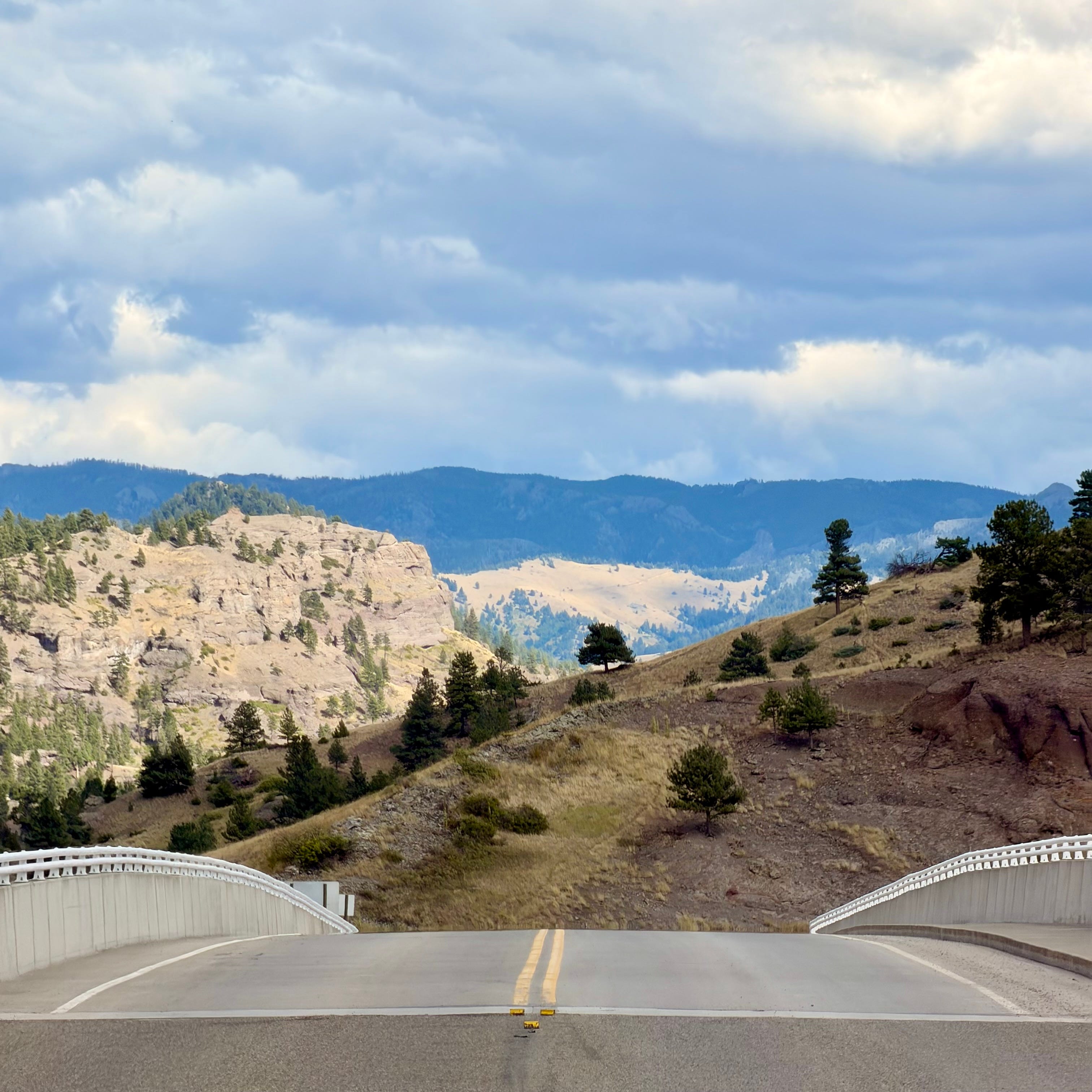
I visited Montana for the first time in September.
My girlfriend and I drove through the Northern Rockies - out of the Helena Valley into the forested mountains of the Continental Divide, westward through wide-open ranchlands, down into the old mining town of Philipsburg.
We spent a couple of nights in the wilderness outside of town, on a sort of writers’ retreat. It was so quiet I could hear the blood pumping in my ears. We listened to rain patter the old skylight and tried not to start a fire while warming the cabin through the ancient wood-burning, cast-iron stove. Bear spray came with us on every walk as a precaution against grizzly encounters - having run into one years ago, I’m not eager to do it again. There was no wind to speak of. The trees stood still as paintings.
We slept when dark fell and rose with the sun.


Our cabin was on a patch of land belonging to an eccentric older couple.
One evening, they invited us up for drinks on the porch.
The husband put a beer in my hand and regaled us with tales of the hunt he led in Alaska, involving an elaborate trap at dusk. He spoke quickly with a grin as crooked as a question mark: “I said to him, I said to my son, don’t you worry, you just go out there and do as I say. I know how to lay a trap - fought in Vietnam, trust me.” Sure enough, they got their game. He showed me a photo of their trophy and fancy gear. Then his eyes wandered to the skylight protruding from our cabin. “That’s from the old opera house in town,” he said. “I wanted it. Enough money will get you anything.”
Later, we outfitted a boat and traveled a stretch of the Missouri River that Lewis and Clark explored in 1805. “Every object here wears a dark and gloomy aspect,” Lewis wrote more than two centuries ago:
The tow[er]ing and projecting rocks in many places seem ready to tumble on us… The river appears to have forced its way through this immense body of solid rock for the distance of 5¾ miles... From the singular appearance of this place I called it the gates of the Rocky Mountains.
Their expedition flung open those gates for the American government.
The fur trade expanded, laying the foundation for future migration and settlement. Indigenous peoples were dispossessed. Mining, logging, railroads. The bison were hunted to near extinction as America remade the West in its own image - land to property, river to resource. “Progress” undirected and inevitable.
“To know how much is enough, and to be satisfied…, makes possible an economy and a society properly suited to the world and to our place in this world,” Berry concluded:
“It is to be civilized. The idea of enough is alien to capitalism, which respects no limit.”
Enough for what?

The trouble, perhaps, is forgetting what we wanted more for in the first place.
The fisherman’s bigger boat might be worth having if it lets him feed more people, travel to new places, or worry less about tomorrow.
But if we spend our lives building bigger boats, never getting around to leading the lives we assumed they’d make possible - then what have we actually gained?


And so I write to you from LA, my purgatory for these past eight months, where I don’t have to worry about a wood-burning stove setting fire to the house - hell, I love oil! - and where a Porsche is parked on the street around the corner.
Just the other day, I walked past a property listed for $8 million. Tree roots pushed up through the pavement outside.
I am a storyteller with one foot in the Hollywood ecosystem - a contracting industry built around money, status, and increasingly, technological efficiency - pursuing a creative career in one of America’s most conspicuous centers of wealth and ambition.
How do I do that without submitting entirely to a culture of perpetual striving, whose understanding of success has become inseparable from accumulation?
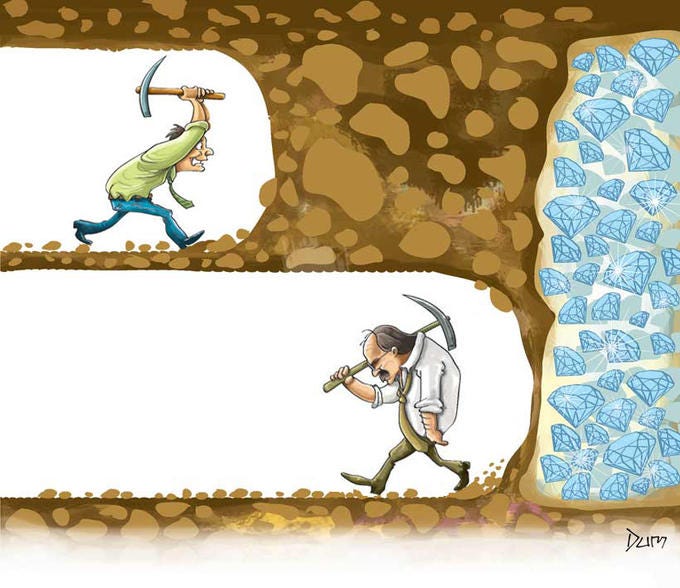
What if the tragedy here isn’t that the miner turned around, but that he turned around as late as he did? All of that time he could have spent sleeping late, playing with his children, strolling the village and drinking wine and playing guitar with his friends.
Or, y’know, writing the stories he wanted to tell, instead of spending a couple of decades trying to earn the opportunity.
On the other hand, if he’d dug just three more feet…

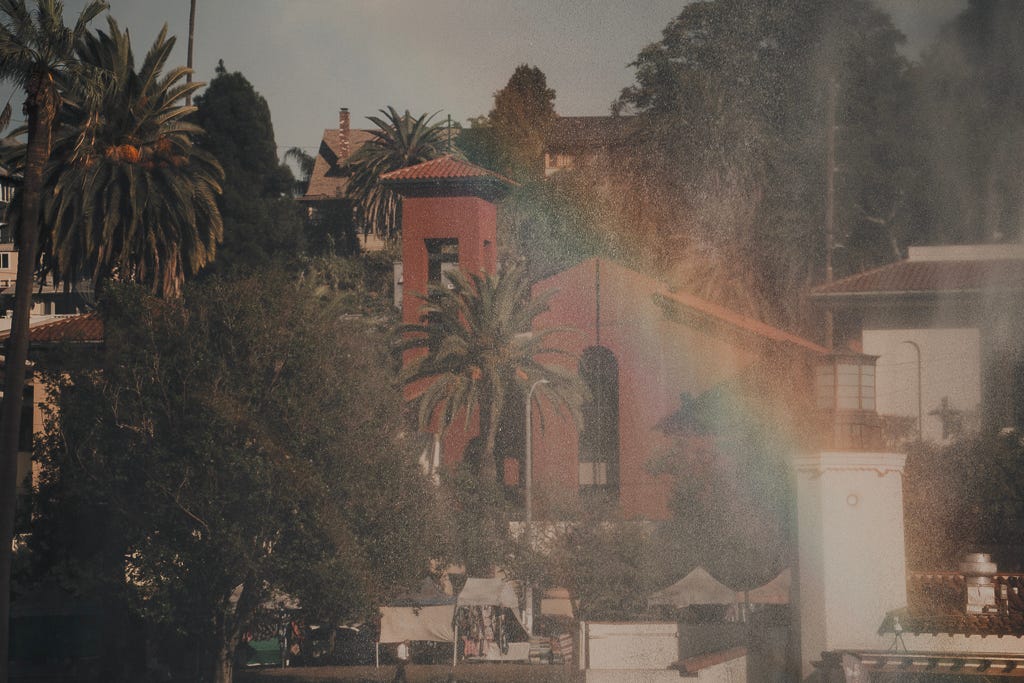
On that gloomy Sunday morning, after every hand in the church congregation had gone up, the priest announced that it was Albert’s birthday.
“Albert! Where is Albert?”, he asked, looking right at Albert in the back row.
Albert rose, a sheepish smile on his face. I’d seen him a couple of times before, taking the collections plate around and caring for his mother in her wheelchair. Now, I watched him walk to the front of the church and share that he was turning sixty-four. The organ flared, not with a hymn but with a rousing rendition of “Happy Birthday”.
We all joined in.
A peanut butter cake with a capital “A” was waiting for Albert after the service. He blew out the candle, cut slices for everyone, and passed them around in silence.
I think he enjoyed watching us eat it together even more than the cake itself.